
Work needs receipts
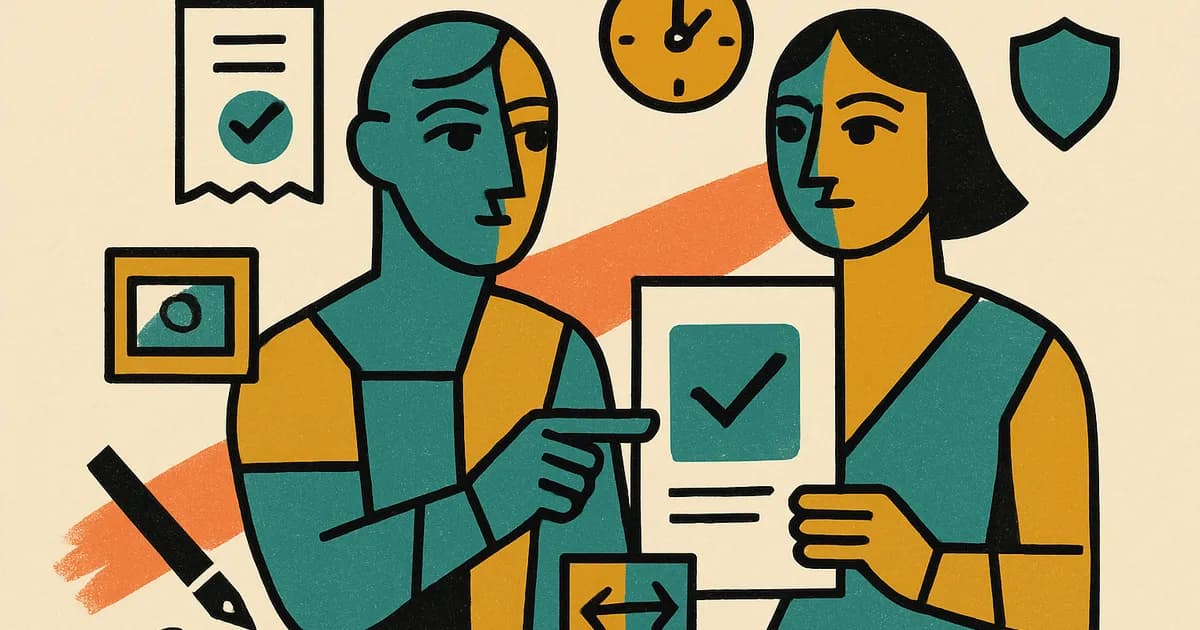
As AI vision and reasoning get cheap, the valuable automation may not be doing the work but proving the work happened. The next quiet product surface is the proof layer: photos, timestamps, signatures, comparisons, and exception trails that decide invoices, refunds, claims, and blame.
The delivery driver is crouched in a hallway taking a photograph of someone’s lunch.
Not the food. The bag. The flat number. The doormat. The small strip of corridor that proves she was on the right floor, outside the right door, at the right time. If the image is too close, it proves nothing. If the flat number is missing, it invites a refund. If the customer opens the door and their face is in shot, the platform now has a privacy problem.
That photo looks like a courtesy update. It is actually the first filing in a future dispute.
A customer says the order never arrived. The merchant says it was made. The platform asks for evidence. The driver says, “I was there.” One image becomes a tiny courtroom.
DoorDash already treats this as operational machinery. Its Dasher guidance for taking delivery photos tells drivers to show the order at the drop-off location, avoid customer faces, and retake unclear photos. The polite consumer-facing story is “your order has been delivered.” The business story is messier: fulfilment has to survive denial, confusion, fraud, bad memory, bad weather, and an angry support ticket at 9:43pm.
Captur pushes the pattern further. Its product checks images before submission: parcel present, label legible, scene plausible, poor capture rejected while the worker is still standing there. That is more interesting than another chatbot demo. The AI is not doing the delivery. It is deciding whether the delivery has enough evidence to count.
The receipt clerk in the workflow
Most AI product discussions still start in the wrong place: can the AI do the task?
Can it write the email, answer the call, book the appointment, inspect the car, diagnose the fault? Sometimes yes. Often poorly. But in many ordinary businesses, the higher-value product is not an agent doing the job. It is a proof layer wrapped around the job.
The valuable AI is not the worker. It is the receipt clerk standing next to the worker.
That sounds small until you list how many businesses run on arguments after the fact:
- Delivered or not delivered.
- Cleaned or still dirty.
- Installed or damaged the wall.
- Returned with a new scratch or an old one.
- Technician attended or customer no-show.
- Roof repaired or leak still there.
- Job completed or “nearly done” with £3,800 still unpaid.
The work is not finished when the human stops working. It is finished when the evidence is strong enough for money, liability, and blame to move.
That shift matters because boring businesses have boring disputes, and boring disputes are expensive. Support agents spend 12 minutes reconstructing a Friday afternoon delivery from notes, timestamps and vibes. Accounts receivable waits because the customer wants proof before paying. A franchise manager refunds £15 because it is cheaper than arguing. A rental company eats damage because the return photos are blurred, late, or missing the roof corner.
AI vision and cheap reasoning do not need to replace the driver, cleaner, installer, claims handler or site supervisor to change the economics. They only need to redefine what “done” means.
Finished = task done + proof captured + exceptions classified + packet ready.
Aviation already knows this
Aviation maintenance has a useful discipline: the repair is not complete until it is logged, signed and traceable. The record is part of the repair. It is not admin sprinkled on top after the engineer puts down the tool.
That sounds excessive if you run a cleaning franchise. It sounds normal if a disputed invoice is blocking cash flow.
AI brings maintenance-log discipline to grocery drops, roof patches, rental cars and bathroom cleans. Not the theatre of it. The mechanism.
A roof repair now has a before shot of the leak path, a close-up of the replaced flashing, a wide shot showing roof position, a timestamp, GPS, technician ID, weather context, a material receipt, and a generated report that the office can send to the homeowner or insurer. The evidence is assembled while the job is still happening, not three days later when someone in accounts emails the crew asking, “Did anyone get a photo?”
That timing is the product.
Bad evidence discovered later is almost useless. Bad evidence caught at source can be fixed in 20 seconds. “Move back so the full door is visible.” “Need one more angle of the passenger-side rear panel.” “Photo too blurry to compare.” “Bathroom mirror still has steam; retake before checkout.”
The annoying prompt is doing commercial work.
How the proof layer works
The user is rarely an “AI user” in the way product decks imagine. They are a driver, cleaner, installer, rental desk clerk, field technician, claims handler or site supervisor with a job to finish and no patience for a clever app.
The trigger is a handoff:
- Job starts.
- Parcel is dropped.
- Vehicle is checked out.
- Vehicle is returned.
- Invoice is submitted.
- Claim is opened.
- Customer complains.
The AI action is narrow and practical:
- Prompt for missing angles.
- Reject blurry captures.
- Detect labels, addresses, fuel gauges or mileage.
- Compare before and after states.
- Ask for a scale reference.
- Classify exceptions.
- Draft the evidence packet.
- Route uncertain cases to a human.
The handoff then moves through the business: worker app to operations console, operations console to support, support to insurer, customer, finance team or payment processor.
This is not autonomy. It is an annoying notary in your pocket.
The buyer does not pay because the model is smart. They pay because the support queue shrinks, chargeback defence improves, refunds stop leaking, invoices go out faster, and managers stop reconstructing reality from WhatsApp messages.
Businesses do not pay for intelligence. They pay for fewer arguments they lose.
The photo timeline becomes the commercial surface
CompanyCam is a good example of the contractor version. Crews take field photos. The office sees a project timeline. Reports and signatures become part of the job record. The interesting bit is not “AI for construction”. The interesting bit is that the photo timeline becomes the shared object between crew, office, homeowner, insurer and accounts receivable.
A site photo starts as documentation. Then it becomes customer communication. Then an invoice attachment. Then insurance support. Then training data for the next job. One capture has several commercial lives.
Tractable shows the vehicle version. Images of a car become a damage ledger across check-in, checkout, rental return, claim estimate and subrogation. A scratch is no longer just a scratch. It is a disputed state change between two moments, with money attached.
The same pattern is coming for dull operational categories that do not usually get keynote slides.
Cleaning visits
A cleaner opens the job. The app asks for the sink, hob, bathroom mirror, toilet base and floor threshold before work starts. It learns the rooms for that property and prompts for the same views at checkout.
The mirror photo is rejected because of steam blur. The hob photo is too close. The bathroom floor is missing. The worker retakes them before leaving.
The next morning the customer complains. Support opens the packet. The before and after angles match. The timestamps are clean. The dirt delta is obvious, or it is not. The support agent either gives a £15 gesture refund or denies the claim without turning the cleaner into a witness.
If no complaint arrives within 24 hours, the invoice is released automatically. Managers only see the red packets: missing room, low confidence, customer disputed, worker override.
That is not an AI cleaner. It is a proof clerk for cleaning.
Rental vans
A customer collects a van. The app forces a phone walkaround: tyres, roof corners, side panels, fuel gauge, mileage, cargo floor. At return, the scan is compared with the baseline.
A new mark appears on the passenger door. The model is unsure: rain, mud and shadow all look plausible. The case routes to a human with the relevant frames side by side. The deposit hold is adjusted by evidence quality rather than by whoever shouts first.
This is where the economics get sharp. Operators can price around proof.
High-quality evidence could mean:
- Lower excess.
- Faster deposit release.
- Instant invoice approval.
- Cheaper insurance premium.
- Better marketplace ranking for workers with clean proof histories.
- Faster payment for contractors who capture complete packets.
Bad evidence becomes expensive. Not morally bad. Commercially bad. If your crew keeps uploading blurry photos from their gallery three hours after the job, the business can no longer treat their work as equally billable, insurable or defensible.
The field worker will fight the product
The hard part is not the model. It is the thirty seconds.
If capture takes too long, workers will hack it. They will upload old gallery photos, photograph ceilings, cover the lens with a thumb, reuse the same parcel angle, or stage the least incriminating view. Not because they are villains. Because the app is between them and finishing the shift.
A proof product has one brutal design constraint: honest capture must be faster than cheating.
That means capture-at-source metadata, GPS, timestamp, device attestation, motion checks and restricted gallery upload for high-risk cases. It also means the prompt has to explain itself in worker language.
“Need one more angle so the customer cannot dispute this later” lands differently from “photo required for quality assurance.”
The first frames the system as protection. The second smells like surveillance.
That wording matters. The proof layer sits at a tense point in the organisation. Operations buys it to reduce disputes. Legal likes the record. Finance likes faster billing. Customer support quietly loves anything that stops detective work. Field teams see one more step added by people who do not carry the mop, ladder or parcel.
If the product treats workers as suspects, they will make it worse. If it treats them as people who also get blamed when evidence is missing, they may tolerate the extra capture.
Generative AI breaks naive proof
There is a darker reason this category will grow: photos are losing their innocence.
For years, a delivery photo or vehicle walkaround worked because images felt like direct evidence. Generative AI weakens that assumption. A picture alone will not carry the same force when everyone knows pictures can be fabricated or altered.
The answer is not blockchain theatre. Most businesses do not need a philosophical proof of reality. They need chain of custody-lite: signed capture, device metadata, location, timestamp, sequence, source restrictions, edit history and a simple way for a customer or claims handler to understand why the packet is trustworthy.
“Captured in-app at 14:07, within 8 metres of the job address, no gallery import, no edits, matched to checkout flow” is boring. Boring is the point.
The product surface will need to expose uncertainty too. A good proof system does not say, “Refund denied: AI confidence 91%.” That is how you turn a support tool into a lawsuit generator.
It should say:
- “Missing after photo for bathroom floor.”
- “Possible shadow, route to human.”
- “Damage existed in pickup baseline.”
- “Label unreadable, driver retake required.”
- “Low confidence due to rain on lens.”
The best systems will make uncertainty operational rather than mystical.
Proof is not the whole service
There is a limit. Some work cannot be photographed well.
Care work, judgement work, negotiation, politeness, smell, whether the customer felt respected, whether a technician explained the trade-off properly: the proof layer captures observable residue, not the whole service.
Model errors will be costly. Dirt can look like damage. A wet driveway can look like an oil spill. A shadow can hide a parcel. An old scratch can be charged as new. A missing angle can be treated as guilt.
So the workflow needs appeal paths, human override and visible uncertainty from day one. The product cannot be a black box that converts incomplete evidence into denied refunds. That is operationally tempting and commercially dangerous.
There is also a cultural failure mode. A business can become so obsessed with proof that every interaction feels pre-accusatory.
“Prove you delivered.” “Prove you cleaned.” “Prove you did not scratch it.”
That ambience changes behaviour. Customers feel distrusted. Workers feel watched. Support teams become appeals judges. The proof layer can reduce arguments while making the whole service feel more adversarial.
The design work is to make evidence feel like clarity, not prosecution.
The new receipt tail
The category name is still unsettled: proof ops, visual assurance, field evidence, receipt layer, dispute automation. The label matters less than the shift.
Ordinary work is growing a receipt tail.
The old workflow ended at completion. The new one ends when the packet can travel: to the customer, to finance, to the insurer, to a marketplace trust team, to a chargeback process, to a manager deciding whether the worker needs coaching or the customer is trying it on.
This changes product design. The capture moment becomes part of the service. The metadata becomes part of the commercial object. The support console becomes less about detective work and more about judgement. Pricing moves from seats and tasks towards completed proof packets, disputed jobs avoided, claims triaged, vehicles per month, technicians per month, or even recovered revenue.
The accounts receivable angle is underrated. Many field businesses do the work, then wait to be paid because the proof is fragmented: photos in one phone, notes in another, customer sign-off missing, insurer asking for angles nobody captured. AI proof packs turn “done” into “billable”.
That is the real reframe. The near future of applied AI is not a parade of digital workers replacing human ones. In a lot of the economy, it is software quietly changing the definition of completion.
The next competitive edge may belong to the company whose workers do the same labour as everyone else, but whose work becomes payable, refundable, insurable and defensible the moment it happens.