
Tokens, Dividends, or Data Wages? Designing UBI for an AI-First Economy
If AI does most work, what does "income" become? This piece explores plausible UBI designs for an AI-heavy future - cash dividends from AI windfalls, "universal basic compute" credits, and data-as-labor royalties - grounded in what we've learned from real basic-income pilots and existing dividend models. It sketches how such systems might emerge, who funds them, and how access to powerful AI could be rationed fairly without stifling innovation.
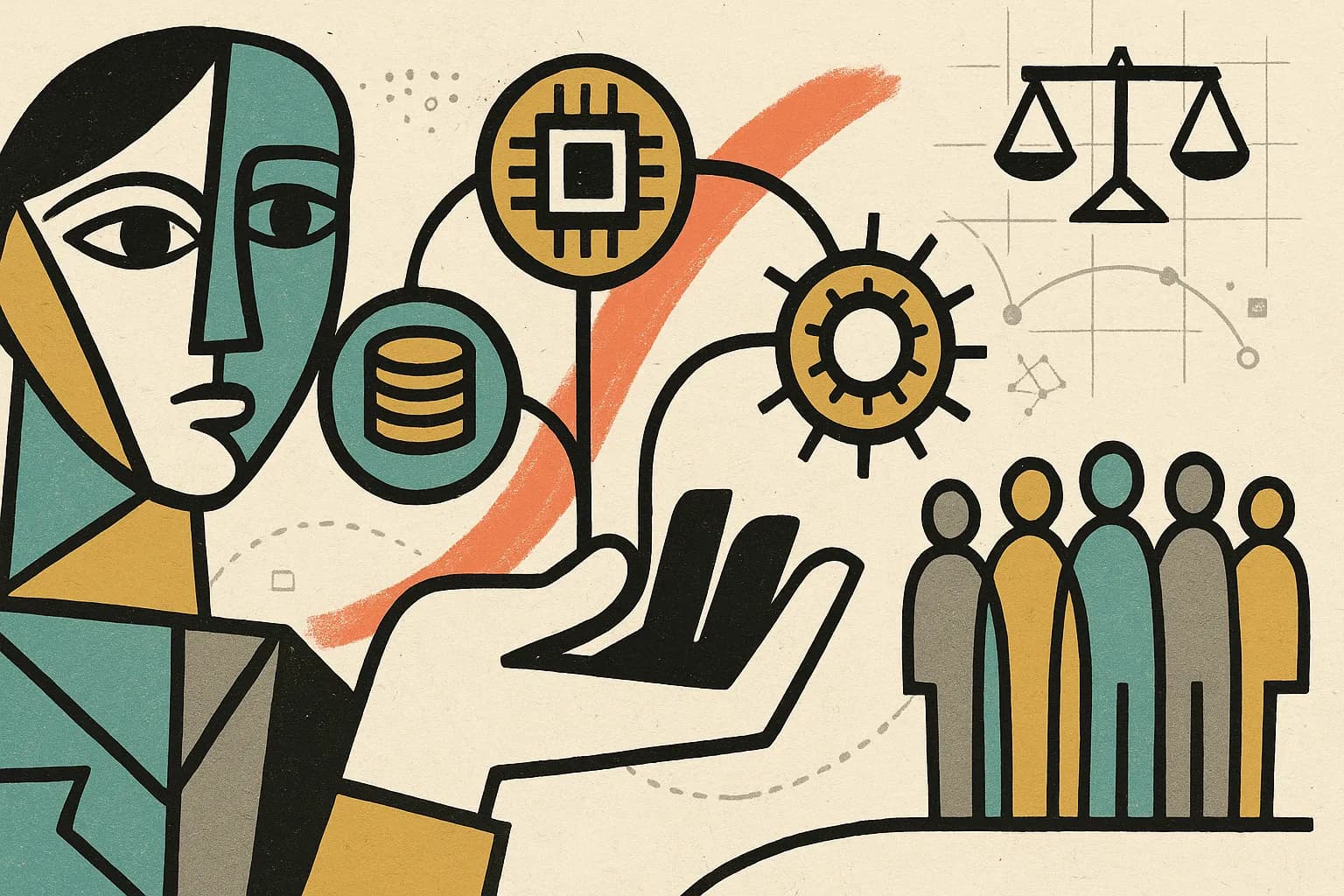
If AI can deliver most goods and services with minimal human labour, we'll still need a way to distribute purchasing power and capability access. Call it income, dividends, or credits - the design matters. We already have real-world hints from basic-income pilots and sovereign dividends; the novel work is stitching those precedents to a future where access to powerful AI and compute may be as foundational as cash.
1) Why UBI re-enters the chat with frontier AI
As automation expands into cognitive tasks, labour income can decouple from production. Before speculating, it's worth grounding in what high-quality pilots actually found.
- Finland's randomised basic-income experiment (2017–2018) reported improved wellbeing and modest, mixed employment effects, not the collapse some feared. Researchers found better mental health and life satisfaction among recipients, while employment impacts were small and statistically uncertain. (julkaisut.valtioneuvosto.fi, Finland Toolbox)
- Stockton's SEED guaranteed-income pilot (US$500/month, 2019–2020) observed reduced income volatility, improved mental health, and - in a widely discussed result - higher rates of full-time employment among recipients after one year. (SEED, PMC)
- GiveDirectly's long-horizon UBI program in Kenya (the world's largest/longest to date) is finding that both monthly UBI and large lump-sum transfers increase investment, earnings, and psychological wellbeing; "laziness" effects did not materialise in early results. (GiveDirectly)
Example implementation: create a national UBI Observatory that ingests administrative data from ongoing trials (employment, health, education), publishes dashboards, and recommends quarterly adjustments to amounts and phase-outs. It's the missing feedback loop between pilots and policy.
2) Where would the money (or value) come from?
Three funding tracks have credible precedents.
Sovereign dividends from shared resources
Alaska's Permanent Fund Dividend (PFD) distributes a portion of state mineral revenues to every eligible resident, annually, and has done so for decades. It's a working model of resource rents → universal dividends; swap oil rents for "AI rents" (e.g., training-run licenses, data-center resource levies) and you have a template. Official materials explain the PFD's mission and calculation mechanics. (Permanent Fund Dividend, Alaska Permanent Fund Corporation)
Windfall sharing from frontier AI profits
Two complementary proposals: Sam Altman's "Moore's Law for Everything," which imagines taxing extreme AI-driven profits to fund broad social dividends, and the Windfall Clause, an ex-ante legal commitment by AI developers to share a fixed fraction of outlier profits with society. Together they sketch a voluntary → statutory continuum for routing AI windfalls to the public. (moores.samaltman.com, arXiv, fhi.ox.ac.uk)
"Data as labor" royalties
Economists have argued for compensating people when their data (or model feedback) creates value - moving from "free" participation to data wages paid via platforms or collectives. This reframes users from product to contributors in a functioning market for data. (American Economic Association)
Example implementation: a Sovereign AI Fund seeded by licensing fees on very large training runs and data-center resource rents; it pays an annual AI dividend (rules-based, like Alaska's smoothing formula) and can top up compute credits in downturns. (Permanent Fund Dividend)
3) What does "income" look like if work is optional?
Cash remains fundamental, but two capability-first instruments fit an AI-heavy economy.
Universal Basic Compute (UBC)
Everyone receives a monthly allowance of compute/AI credits redeemable at certified providers - a public option for cognition. It's akin to spectrum/broadband policies: ensure baseline access, let markets do the rest. Credits meter access to premium models without pricing out citizens.
Service vouchers via personal agents
Households allocate AI credits to run a personal firm: tax filing, benefit navigation, grant applications, local micro-production, custom tutoring. Top-ups for care, education, or disability create targeted capability without means-testing the base.
Example implementations:
- Compute allotments distributed via digital ID; unused credits auto-auction back to providers, with proceeds funding cash UBI (mirrors cloud credit buy-backs / spectrum auctions).
- Public AI kiosks in libraries: benefit triage, small-business paperwork, translation and accessibility services - backed by shared compute pools.
4) How might it actually emerge? (Path dependency matters)
Phase 1 - Local & philanthropic pilots
Guaranteed-income pilots continue to build evidence and policy muscle memory (e.g., Stockton's SEED; GiveDirectly's long-form UBI). Pair every pilot with transparent, open-data dashboards. (SEED, GiveDirectly)
Phase 2 - Sectoral dividends
Introduce AI-sector levies where public infrastructure/resources are clearly implicated (e.g., national licenses for frontier-scale training runs; grid/water/land rents for hyperscale data centers), routing proceeds into a sovereign fund that pays annual dividends and UBC credits.
Phase 3 - National settlement rails
Roll out digital IDs and audit-friendly wallets that can hold cash, compute credits, and data-wage entitlements. Offer an opt-in module for citizens to contribute model feedback or labeled data in exchange for royalties - priced transparently and revocable.
Example implementation: a "Windfall switch" embedded in large-model licenses - if profits cross a predefined threshold, a fixed share auto-routes to the Sovereign AI Fund (a practical take on the Windfall Clause concept). (fhi.ox.ac.uk)
5) Guardrails: access, fairness, and anti-capture
To stay legitimate, a UBI/UBC system needs strong design constraints.
- Fair access to frontier models: reserve a baseline tier for public/educational use; meter premium capability with per-capita credits so access isn't purely wealth-based.
- Privacy & consent for data wages: pay via privacy-preserving reporting; contributions are voluntary and revocable; publish pricing methodologies for transparency. The "data as labor" literature emphasises the need for countervailing power and clear consent. (American Economic Association)
- Inflation & macro stability: size dividends by rule (e.g., multi-year averaging like Alaska) to avoid pro-cyclical shocks; publish a stabiliser that smooths payouts and compute credits over the business cycle. (Permanent Fund Dividend)
Example implementation: a two-tier AI access charter - baseline models free for civic tasks, advanced models accessible via per-person credits plus means-tested top-ups for education, disability, and small-business formation.
6) If we're all "autonomous," what do people actually do?
In the optimistic scenario, individuals run agent swarms that multiply personal productivity - one person doing the "jobs of thousands" for themselves. That shifts status and meaning from hours sold to projects, care, and creation. A blended UBI/UBC floor covers the basics; agents do the grunt work; humans choose what matters.
Example implementation: civic bounties - governments post outcome-bounties (e.g., energy-efficiency retrofits filed correctly; accessible public information translated). Personal agents claim, complete, and submit proofs; citizens are paid for verifiable local progress.
7) Open questions to take seriously
- Political durability. Alaska's PFD shows that even beloved dividends can be contested when budgets bite; rules-based governance and transparency are essential. (AP News)
- Global equity. If AI rents concentrate in a few jurisdictions, should there be cross-border compacts or development-oriented transfers funded by AI windfalls?
- Innovation vs. entitlement risk. Compute credits must act as a floor, not a moat around incumbents. Design auctions and open standards to keep entry possible.
8) What to prototype in the next 12–24 months
- City-level "AI dividend." Capture measured savings from public-sector automation (document processing, eligibility checks) and share them back to residents as small cash + compute stipends; publish quarterly ledgers.
- National compute stipend for students/SMEs. Treat compute like a utility: metered, audited, and fairly priced; measure learning and productivity outcomes.
- Data-for-cash pilots. Stand up opt-in data wage markets using standardised licenses and privacy tech; publish prices and allow revocation, building on the "data as labor" framework. (American Economic Association)
Frequently raised critiques (and replies)
"Won't people stop working?" Randomised trials in Finland and Stockton did not show mass withdrawal from work; some found increased full-time employment and reduced financial volatility - consistent with the idea that a secure base lowers frictions to better jobs. (julkaisut.valtioneuvosto.fi, SEED, PMC)
"Dividends get politicised." True. Alaska's history argues for boring rules (multi-year smoothing, clear eligibility) and independent administration to survive fiscal cycles. (Permanent Fund Dividend)
"How do we pay for it?" Start with sectoral rents (training-run licensing, resource levies), add windfall sharing for outlier profits, and let data wages cover the contribution side. None precludes progressive tax reform; they complement it. (arXiv, fhi.ox.ac.uk, American Economic Association)
Closing argument
UBI in an AI-first economy won't be one thing. The most workable path looks like a bundle:
- Cash dividends from shared AI rents and windfalls,
- Universal Basic Compute to guarantee capability access, and
- Data wages for genuine contributions - delivered over auditable rails with rules that are clear enough to survive politics and cycles.
We don't have to start from fiction. We have Finland, Stockton, and GiveDirectly for evidence on human outcomes; Alaska for a durable dividend model; and concrete proposals for windfall-sharing and data compensation. The new work is connecting these pieces to the realities of frontier AI - and making the benefits broadly, fairly, and predictably accessible. (julkaisut.valtioneuvosto.fi, Finland Toolbox, SEED, PMC, GiveDirectly, Permanent Fund Dividend, arXiv, fhi.ox.ac.uk, American Economic Association)