
Synthetic Market Twins: Privacy-safe, cross-company experiments that set price and inventory in real time
A near-future sketch of "market twins": shared, privacy-preserving simulations fed by many firms that run experiments, discover efficient prices, and nudge inventory - without exposing raw data or colluding.
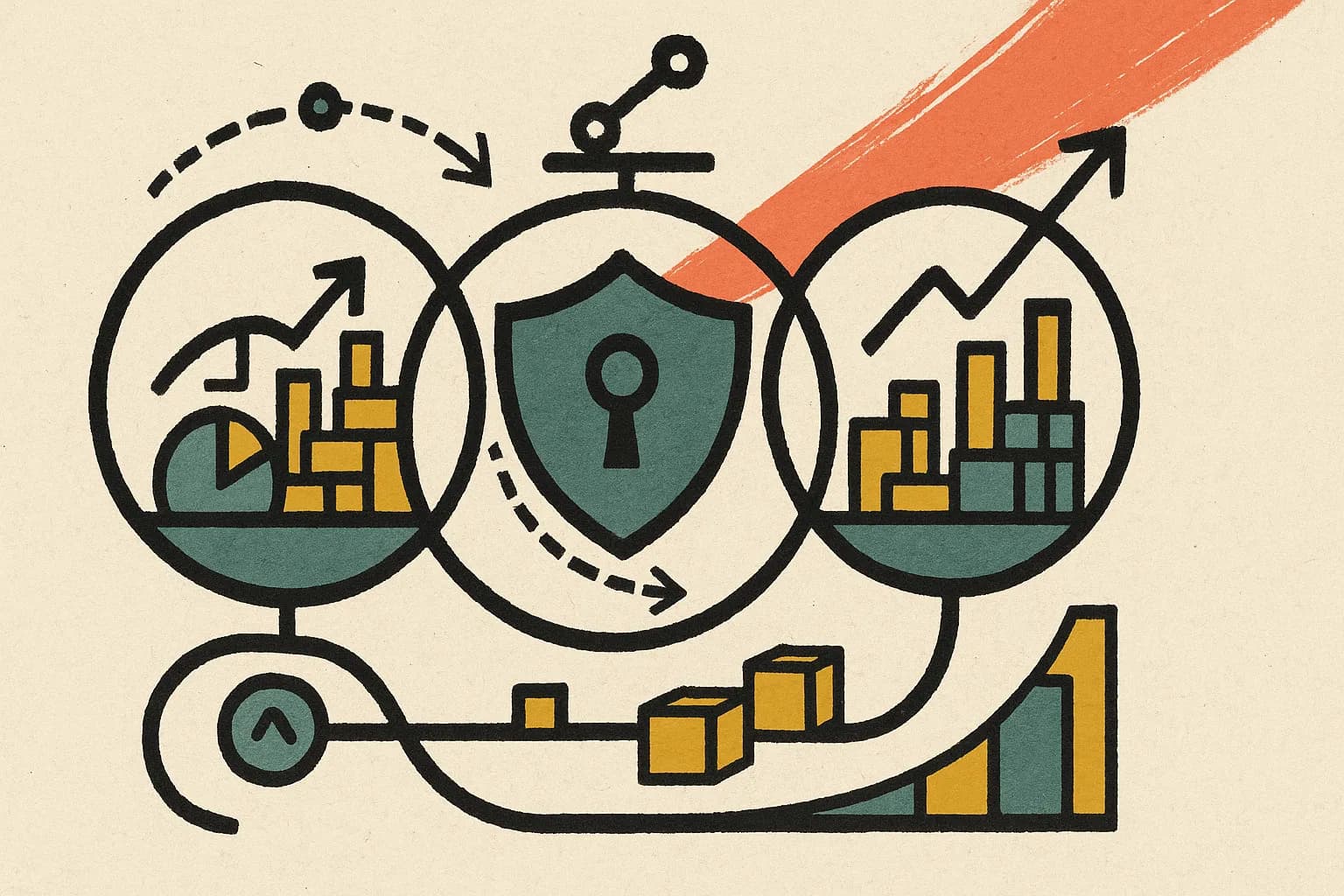
Most companies already tune price and inventory with their own data. The leap is doing this together - multiple firms feeding a shared, privacy-preserving simulation that runs controlled experiments and returns actionable, firm-specific recommendations in near real time. Call it a Synthetic Market Twin: a compute space where competitors, suppliers, and logistics partners contribute encrypted signals, explore "what ifs," and get individual outputs - no raw data shared, no secret back channels, and auditable safeguards against collusion.
Why this, why now
Three rails have matured at once. First, data clean rooms let organisations compute over each other's data with strong access rules and built-in controls like differential privacy; major platforms now ship this natively. (Snowflake Documentation, Amazon Web Services, Inc.) Second, privacy-enhancing technologies (PETs) such as differential privacy, secure multi-party computation, and federated learning have moved from theory to guidance and production deployments. (NIST Publications, NIST Computer Security Resource Center, Proceedings of Machine Learning Research) Third, event standards like GS1 EPCIS 2.0 make it practical to stream inventory and shipment facts across firms in a common schema. (GS1)
What a Synthetic Market Twin is (and isn't)
It is a shared experiment harness: a neutral environment where parties publish aggregated or privacy-protected demand, price, inventory, and logistics signals; propose interventions (price tests, allocation shifts); and receive personalised policy-safe recommendations. It is not a place to swap everyone's prices or to coordinate outcomes. Competition law remains the guardrail; the twin works only if its design prevents illegal information exchange and preserves independent decision-making. (competitionandmarkets.blog.gov.uk, European Papers)
How it might work (end-to-end)
1) Signals in, safely
Each participant streams a minimal set of fields - e.g., item, region, stock position, fulfillment lead time, recent price and demand elasticities - never raw customer identifiers. Streams land in clean rooms with query rules and logs; sensitive aggregates add differential privacy to bound leakage. Where joint model training helps (e.g., regional demand shocks), participants use federated learning or secure aggregation so the shared model learns without moving raw data. (Amazon Web Services, Inc., Proceedings of Machine Learning Research)
2) Compile a live "market twin"
The platform synthesises a dynamic model of supply, demand, and constraints. EPCIS-style logistics events enrich the state (what moved, where, when), giving the twin a factual backbone for availability and lead times. (GS1)
3) Run policy-safe experiments
Participants submit experiment intents ("lift price 2–5% for SKU set in region A if stock > X") along with competition-law-aware constraints (no sharing of current or future individual prices; results must be firm-specific and differentially private). The twin runs multi-arm bandits / counterfactual simulations to estimate impacts, then proposes per-firm actions and confidence bands. Clean-room logs provide a paper trail. (Amazon Web Services, Inc., NIST Publications)
4) Recommendations out, not secrets
Each firm receives only its own recommended prices and allocations, plus coarse market health signals (e.g., demand shock likelihood) with privacy guarantees. No party sees a competitor's granular strategy or data.
5) Continuous learning with drift watch
Models re-fit as fresh EPCIS events and sales aggregates arrive, with drift detection that pauses recommendations if data shifts beyond policy bounds - again logged inside the clean room. (Snowflake Documentation)
A reference stack (conceptual)
flowchart LR
  A[Participants\n(ERPs, OMS, WMS)] -->|DP aggregates / FL updates| B[Clean Rooms & PET Layer]
  B --> C[Synthetic Market Twin\n(state + simulators)]
  C --> D[Experiment Engine\n(bandits / counterfactuals)]
  D --> E[Policy Gate\n(antitrust + privacy checks)]
  E --> F[Firm-Specific Recos\n(price, allocation, reorder)]
  B --> G[Evidence Ledger\n(queries, DP epsilons, approvals)]
- PET Layer: differential privacy (with tested guarantees), secure MPC/aggregation, and federated learning to keep raw data local. (NIST Publications, e3s-conferences.org, Proceedings of Machine Learning Research)
- Evidence Ledger: immutable logs of who queried what, with clean-room analysis logs and DP parameters - useful for audits. (Amazon Web Services, Inc.)
- Policy Gate: automated checks against info-exchange risks and "algorithmic collusion" patterns; recommendations must be independently computable and not contingent on competitors' specific prices. (competitionandmarkets.blog.gov.uk, The Regulatory Review)
Novel design patterns
Programmatic antitrust. Encode horizontal-guideline constraints as code: ban queries that reconstruct competitor price paths; throttle experiment cadence; and require independence proofs (e.g., your recommendation changes only with your costs/constraints, not a rival's specific bid). This shifts compliance from training slides to compute policy. (competitionandmarkets.blog.gov.uk, European Papers)
Confidence as a contract. Recommendations ship with statistical confidence and the privacy budget expended (epsilon). Finance can then govern risk - e.g., accept actions only above a confidence threshold and within an epsilon budget per quarter, aligning to NIST guidance on evaluating DP guarantees. (NIST Publications)
Zero raw joins. Instead of centralizing data, use federated joins or secure MPC to compute cross-firm metrics (e.g., regional stockout risk) without exposing tables. The twin gets the metric; nobody sees the join keys. (e3s-conferences.org)
Event-first reality. Make logistics the source of truth via EPCIS 2.0 events. When a pallet leaves a site or arrives at a depot, the twin's state updates instantly, shrinking the lag between physical movement and price/availability decisions. (GS1)
Risks, ethics, and law
The promise dies if the twin becomes a coordination tool. Bake in independence, privacy, and logging from day one; give regulators and internal counsel a read-only window into clean-room logs and policy checks. Track the public debate on algorithmic pricing and collusion - rules are evolving and your controls should evolve with them. (The Regulatory Review, Bird & Bird)
What to pilot first
Start with two non-competing partners that share a bottleneck - say a supplier and a retailer - then add a single competing retailer under strict clean-room policies. Use a Snowflake or AWS clean room to prototype; limit scope to one SKU family and one region; send only aggregates with differential privacy; and measure time-to-insight and forecast error vs. baseline. If the guardrails hold, expand the SKU set and participants. (Snowflake Documentation, Amazon Web Services, Inc.)
Thesis: Markets don't just clear; they learn. A Synthetic Market Twin lets firms learn together - safely - by turning privacy tech, clean rooms, and event standards into a shared laboratory. If you can prove that recommendations are private, independent, and auditable, you get the upside of cross-company learning without losing control or crossing legal lines. (Snowflake Documentation, NIST Publications, GS1, competitionandmarkets.blog.gov.uk)